The Ferocious Rhythms of Afrobeat: Fela Kuti’s 1970s Lagos Revolution
In the vibrant crucible of 1970s Lagos, Fela Kuti fused West African traditions with jazz and funk to forge Afrobeat, a powerful sound of both music and political defiance. His groundbreaking work at the Afrika Shrine resonated far beyond Nigeria, forever changing the global musical landscape.
The humid, pulsating air of 1970s Lagos was a crucible where sound and struggle forged something utterly new: Afrobeat. At its epicentre was Fela Anikulapo Kuti, a visionary bandleader whose music wasn't just entertainment but a fierce, polyrhythmic confrontation with power, blending the complex traditions of West African music with the urgent energy of American funk and jazz. It was a sound born of a specific place and time, yet destined to echo across continents, redefine genres, and inspire generations.
From Highlife to a New Sound
Born Olufela Olusegun Oludotun Ransome-Kuti in Abeokuta, Nigeria, in 1938, Fela’s early musical journey took him through classical training in London, where he studied trumpet at Trinity College of Music. Returning to Nigeria in the early 1960s, he immersed himself in highlife, a popular West African genre blending jazz, traditional Igbo and Akan melodies, and brass band aesthetics. His band Koola Lobitos, formed in London in the early 1960s, later began experimenting, infusing highlife with jazz improvisation and the burgeoning sounds of American soul and funk. Their early singles, like "My Lady's Frustration," hinted at the dynamic shifts to come.
A pivotal moment arrived during a 1969 tour of the United States. In Los Angeles, Fela encountered Sandra Izsadore, a Black Power activist and dancer, who introduced him to the writings of Malcolm X and Eldridge Cleaver. This intellectual and political awakening profoundly reshaped his artistic purpose. He recognized the superficiality of imitating Western pop and resolved to create music rooted in African identity and struggle. The band, now renamed Nigeria '70 and soon after Africa '70, returned to Lagos, and the metamorphosis began. The highlife’s gentle sway was replaced by a relentless, driving groove, anchored by Tony Allen’s intricate drumming, a signature, hypnotic bassline, and Fela’s distinctive call-and-response vocals, often delivered in Pidgin English, Yoruba, or a blend of both.
The intricate layering of rhythms – from traditional Yoruba drumming to James Brown’s funk – alongside extended, searing horn solos and Fela’s own raw, often satirical vocals, coalesced into Afrobeat. Tracks stretched to ten, fifteen, even thirty minutes, allowing the groove to evolve organically, building a trance-like intensity that was both exhilarating and deeply meditative. Early albums like Fela Fela Fela (1970), Open & Close (1971), and Roforofo Fight (1972) began to solidify this new sound, charting a path away from the more melodic, song-oriented structures of highlife towards a raw, percussive, and politically charged sonic landscape.
The Shrine: Music as Confrontation
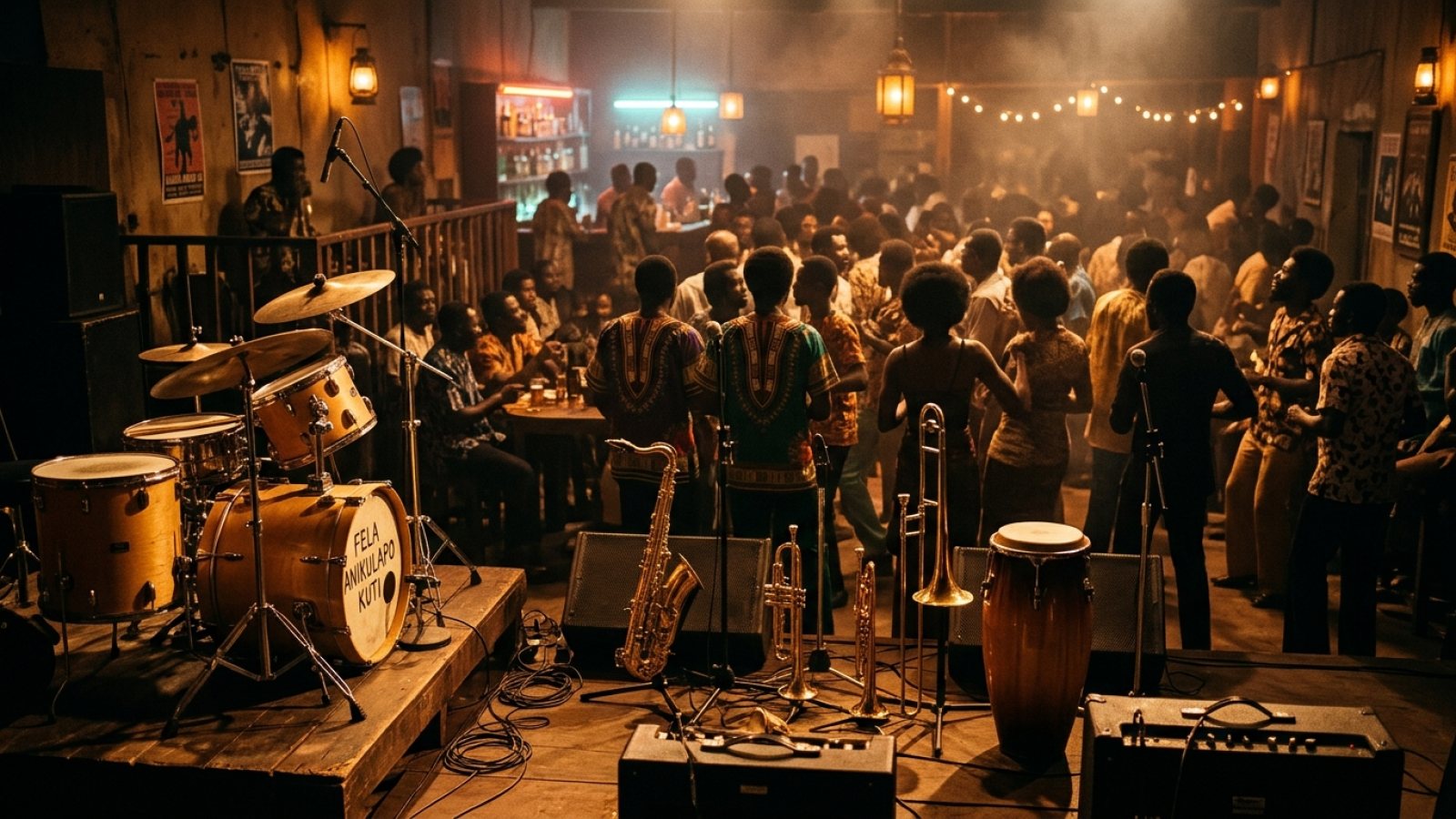
The true engine room of Afrobeat was Fela’s club, the Afrika Shrine, later simply 'The Shrine,' located first at Empire Hotel then at Pepple Street, Ikeja. It was more than a venue; it was a sanctuary, a political forum, and the heart of his self-declared Kalakuta Republic. Here, Fela, clad often in just his underwear or a dashiki, would lead Africa '70 through marathon performances, conducting his sprawling ensemble with a shamanistic intensity. The Shrine became a focal point for Lagos’s youth, intellectuals, and disaffected, drawn by the potent blend of music, dance, and uncompromising political discourse.
Fela's lyrics, once more focused on social observation, transformed into direct attacks on the Nigerian government, military, and neocolonialism. Albums like Gentleman (1973), Expensive Shit (1975), and Zombie (1976) were not just records; they were manifestos. "Zombie," in particular, a scathing critique of the Nigerian military as mindless automatons, became an anthem of defiance but also provoked brutal retaliation from the authorities. The recording process itself, often at EMI Studios in Lagos, captured this raw energy, translating the live intensity of The Shrine onto vinyl.
The music and the message were inseparable. Afrobeat was a sound of liberation, designed to awaken and challenge. Its impact reverberated through Lagos, fueling dissent and offering an alternative vision of African identity rooted in pride and self-determination. Fela's embrace of pan-Africanism and traditional African spiritualism further solidified his role as a cultural icon and a thorn in the side of the establishment, making him a symbol of resistance far beyond Nigeria’s borders.
A Global Rhythmic Imperative
While Afrobeat was intrinsically tied to 1970s Lagos, its influence quickly transcended geographical boundaries. Records pressed by labels like Decca and EMI found their way to Europe and North America, captivating musicians and listeners with their unprecedented rhythmic complexity and raw emotional power. Fela himself toured internationally, notably performing at the Berlin Jazz Festival in 1978, introducing his unique blend of music and activism to an eager global audience. Though sometimes misunderstood or patronized by Western media, the undeniable force of Afrobeat resonated, paving the way for future dialogues between African and diasporic music forms.
Decades later, Afrobeat's DNA is woven into the fabric of contemporary music worldwide. Its polyrhythmic architecture and extended grooves have influenced hip-hop, electronic music, jazz, and rock. Artists from Talking Heads to Common have cited Fela as an inspiration, and his legacy continues to be championed by his sons, Femi Kuti and Seun Kuti, who carry the torch, maintaining The Shrine and introducing new generations to the irresistible power of Afrobeat. From the dusty streets of Lagos to global stages, the sound Fela forged remains a vital, revolutionary force.
The clatter of Lagos traffic, the thrum of a thousand conversations, the insistent pulse of the congas and the searing blast of brass – all of it echoes in Afrobeat, a testament to Fela Kuti’s genius. It’s a sound that refuses to stand still, forever demanding attention, forever challenging, forever dancing.
