
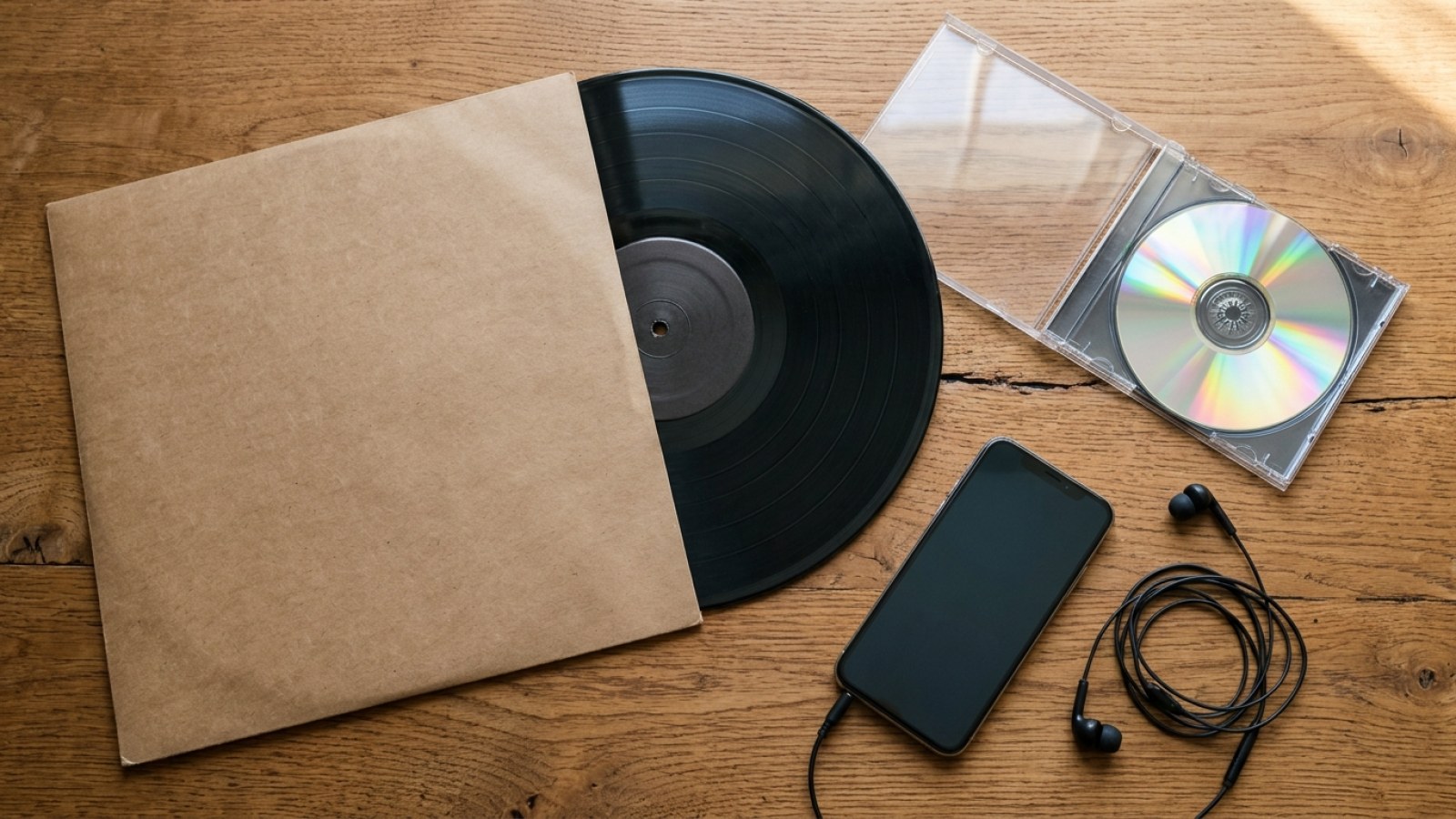
From the LP to the Stream: Three Formats That Changed How the World Listens
In 1948 a record side grew from under five minutes to more than twenty. In 1982 music became numbers on a silver disc. Today it arrives through a phone from anywhere in the world. Each format reshaped what musicians recorded and how listeners heard it.
The shape of a piece of recorded music has always followed the shape of the thing that carries it. A three-minute song, a forty-minute album and an endless playlist are not only artistic choices; they are what the shellac disc, the vinyl LP and the streaming service each made easy. Three dates on our timeline mark the moments that shape changed: 1948, 1982 and the present day. They follow on from the story of Edison's cylinder and Berliner's disc, which made recorded sound something people could buy.
1948: Twenty-Five Minutes a Side
Before 1948, nearly all records for home use were heavy discs of shellac, an abrasive and noisy compound, spinning at about 78 revolutions per minute. A twelve-inch 78 held less than five minutes per side. A symphony meant a stack of discs and a listener getting up again and again to turn them.
At CBS Laboratories, the research scientist Peter Goldmark led a Columbia team charged with making a record that would hold at least twenty minutes per side. Goldmark chose the team and handed much of the experimental work to William S. Bachman and Howard H. Scott. The research began in 1939, paused during the Second World War and resumed in 1945. On June 21, 1948, Columbia Records unveiled the result at a press conference in New York's Waldorf Astoria: a fine-grooved disc of vinyl, played with a narrower "microgroove" stylus at 33⅓ rpm. A twelve-inch side could run about 25 minutes. The first release ran to 133 recordings, and Columbia's catalogue listed Mendelssohn's Violin Concerto in E minor, with Nathan Milstein and the New York Philharmonic under Bruno Walter, as the first twelve-inch LP.
RCA Victor answered with the smaller seven-inch "45" for singles, and the two formats settled into the roles they still have: the single for the song, the LP for the album. Stereo sound was added to the LP in 1957. The long-playing record made room for the album as a work in its own right, and the years that followed are now remembered as the album era.
1982: Music as Numbers
The next change replaced the groove altogether. Philips and Sony developed the compact disc together and set out its audio standard in 1980, in a document known as the "Red Book" after the colour of its cover. Sound was stored as two channels of 16-bit digital samples, taken 44,100 times a second, and read by a laser rather than a needle. A standard disc, 120 millimetres across, held up to 74 minutes of audio.
The CD went on sale in Japan in October 1982, and the record industry began its move to digital. The format proved enormously durable: by 2007, more than 200 billion compact discs of all kinds, including computer CD-ROMs and recordable discs, had been sold worldwide. It also meant that music now existed as data, and data could be copied.
Today: Every Country, Every Phone
That consequence arrived in June 1999, when Napster let people share music files with one another across the internet. Lawsuits shut it down in July 2001, but the idea of music without a physical object did not go away. Apple opened the iTunes Store on April 28, 2003, selling single songs as downloads.
Streaming took the next step and stopped selling copies at all. Spotify, founded in Stockholm in April 2006 as a legal alternative to piracy, launched in several European countries in October 2008 and in the United States in July 2011. By 2013, on-demand streaming had begun to overtake download stores as the main source of digital music revenue, and by 2021 paid streaming subscriptions alone brought the industry $12.3 billion, according to the International Federation of the Phonographic Industry.
Streaming carries recordings from everywhere to everyone, and the charts now hold songs in Spanish, Korean and many other languages. The older formats have not disappeared. Vinyl has come back, and new records are still called LPs, seventy-eight years after Columbia's press conference. What changed most is the listener's reach: a format that once held twenty-five minutes on one side of a disc now opens onto almost the whole recorded history of music, from any phone.
