Umm Kulthum: The Voice That Held a World Spellbound
For over half a century, the voice of Umm Kulthum commanded unparalleled attention, uniting millions across the Arab world in rapt attention. Her epic concert nights became legendary events, broadcast live to an audience stretching from the Atlantic to the Arabian Gulf.
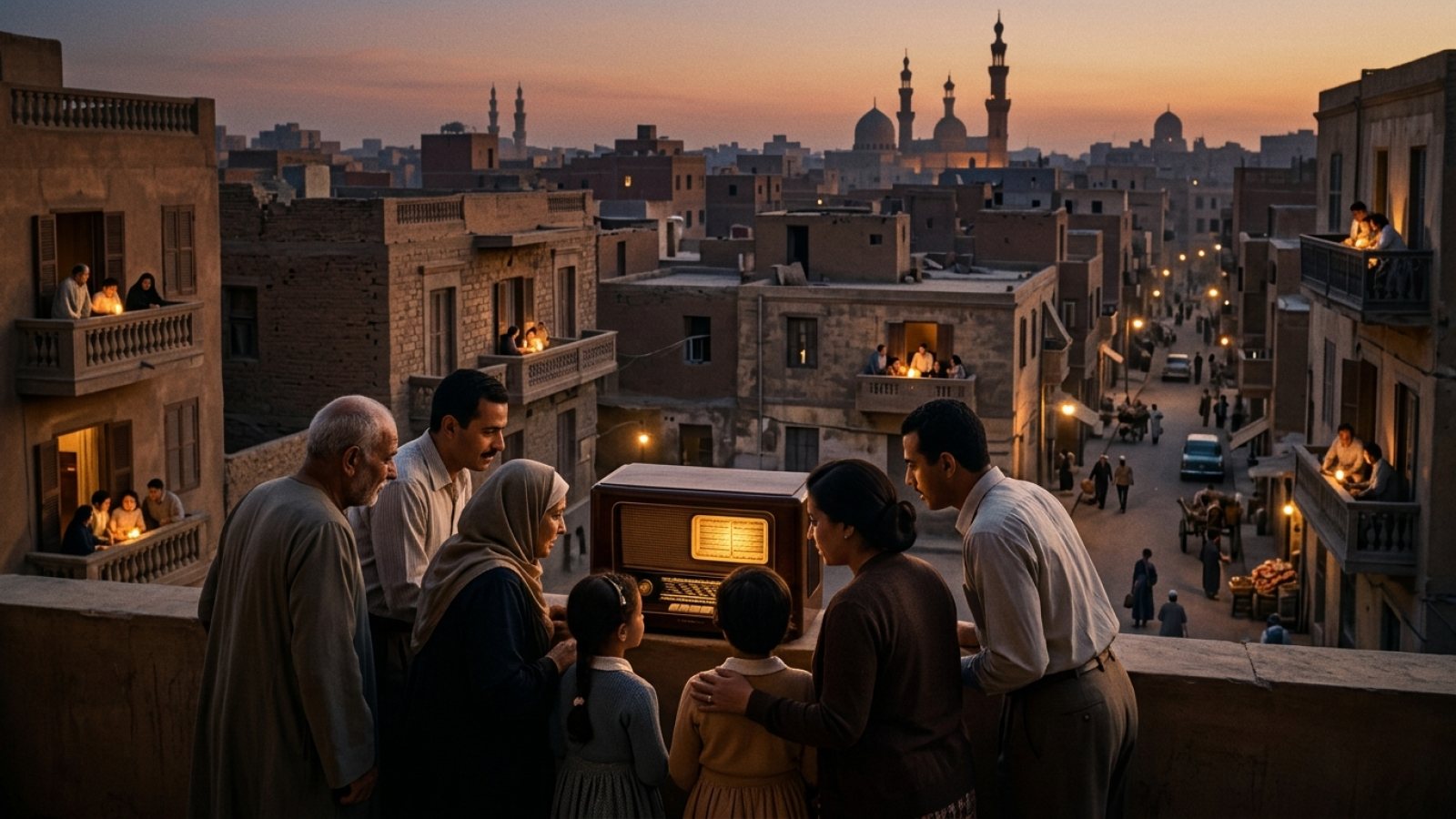
Imagine Cairo on a Thursday night in the mid-20th century. The usually vibrant city, a symphony of street life, would noticeably quieten. Radios across Egypt and the wider Arab world would hum, families gathered, café conversations hushed. This wasn't for news, but for a voice – the voice of Umm Kulthum, a phenomenon whose epic performances could stretch for hours, captivating millions with a singular intensity.
From Delta Village to Cairo's Spotlight
Born Fāṭima Ibrāhīm as-Sayyid al-Biltāgī in Tamay ez-Zahayra, a small village in Egypt’s Nile Delta, likely around 1904, Umm Kulthum’s prodigious talent was evident from an early age. Her father, an imam, initially disguised her as a boy to allow her to perform traditional religious recitations, or tilawa, at local celebrations. This early grounding in classical Arabic poetry and vocal improvisation laid the foundation for her unparalleled command of language and melody. By the early 1920s, with the support of her family, she moved to Cairo, the burgeoning cultural capital of the Arab world. Here, she shed the traditional male attire, adopted the stage name Umm Kulthum, and began navigating the city’s vibrant music scene, collaborating with composers and poets who recognized her extraordinary gift.
The Architecture of Tarab: Crafting Ecstasy
Umm Kulthum’s ascent coincided with the dawn of Egyptian radio in the 1930s. Her weekly live concerts, broadcast nationwide and across the region, transformed her into a household name. Unlike many contemporaries, she embraced the microphone as an extension of her voice, mastering its nuances to convey an astonishing range of emotion and power. Her performances were not merely concerts; they were spiritual journeys into tarab, a state of musical ecstasy and enchantment. Each song, often a sprawling epic lasting an hour or more, was a collaborative improvisation between her and her orchestra, building to emotional crescendos that left audiences spellbound.
She worked with the era's most esteemed composers, including Mohammad El Qasabgi, Zakariyya Ahmad, Riad Al Sunbati, and later, Baligh Hamdi, who composed some of her most enduring hits like “Enta Omri” (You Are My Life) and “Alf Leila wa Leila” (A Thousand and One Nights). Her unparalleled vocal technique, a potent blend of classical Arabic melodic ornamentation and raw emotional power, allowed her to re-interpret verses, hold notes for impossibly long stretches, and explore every facet of a phrase until it resonated deep within the listener’s soul. This dedication to the musical moment, the shared experience of tarab, made her concerts unique.
A Voice for the Nation, a Sound for the World
Umm Kulthum's influence extended far beyond Egypt's borders. Her records, distributed by labels like EMI's His Master's Voice, found their way to Beirut, Damascus, Baghdad, Tunis, and Casablanca, establishing her as a pan-Arab icon. She became a symbol of Arab unity and cultural pride, particularly during periods of political upheaval. Her concerts, often held to raise funds for national causes, underscored her commitment to her homeland and the wider Arab collective. Her funeral in Cairo in 1975 was an event of national mourning, with millions taking to the streets, a testament to her profound connection with her people.
Today, Umm Kulthum’s voice continues to resonate. Her recordings are foundational to Arabic music studies, revered by new generations of singers and musicians who seek to understand her mastery. Her innovative vocal techniques and the architectural grandeur of her compositions have inspired global artists, with her voice sampled in contemporary music and celebrated across continents. Long after the Thursday night silence lifted, the golden voice of Umm Kulthum remains, a constant source of wonder, bridging generations and borders through the sheer power of her artistry.
